

The arithmetic of gain and loss cannot settle a question of right and wrong.
The Grace of a Folding Fan
The expression brings together two Chinese characters: 枉, “to bend,” and 直, “to extend.”
In his Eastern Han commentary on Mencius, Zhao Qi explains that the longer of the saying’s two ancient measures of length equals eight of the shorter. A small bend promises eight times the reach. Judged by length alone, it is a handsome bargain.
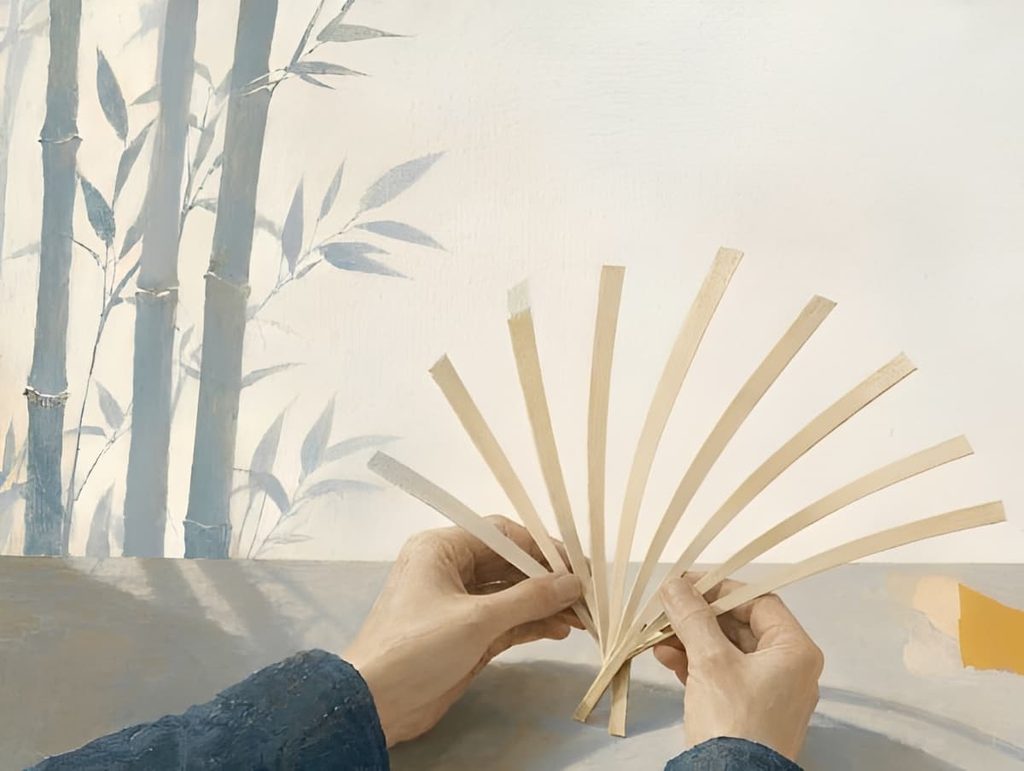
Consider a folding fan with bamboo ribs: closed, it fits in the palm; open, it spreads into a generous arc.
Its ease of movement depends on the ribs staying in place, not on their freedom to twist. The fan can fold inward and change its shape; the framework holding it together must remain aligned.
Two Ways of Reckoning
In “Duke Wen of Teng, Part II,” a chapter of Mencius, the student Chen Dai questions his teacher’s refusal to call on the rulers of the day. His teacher, he thinks, is making too much of a minor formality. A visit might persuade a ruler to govern benevolently—the “kingly way”—or at least help him establish supremacy among the states.
Drawing on a saying in the Records—“Bend one measure to gain eight in reach”—Chen Dai urges a little accommodation so that his teacher’s political ideals can be put into practice. Considered only in terms of the outcome, his case has merit.
Chen Dai is weighing gains against losses; Mencius is asking what goes on the scale. If one measure may be bent today, might eight be bent tomorrow? A boundary need not collapse all at once. It can fade under the repeated assurance that this time is an exception.
The Price of a Full Haul
The story Mencius tells next comes from the Spring and Autumn period. Zhao Jianzi (Zhao Yang), a senior minister in the state of Jin, asked the skilled charioteer Wang Liang to drive for his favorite courtier, Bi Xi, on a hunt. Wang Liang drove as the rules required, but a full day’s hunting brought them nothing. He was dismissed as the worst charioteer in the world.

On the next outing, he set those rules aside and drove to suit the archer. In a single morning they took ten animals, and the world’s worst charioteer was suddenly hailed as its best. Zhao Jianzi wanted Wang Liang to drive exclusively for Bi Xi. Wang Liang declined.
He understood the terms of that success. A day spent following the rules had left them empty-handed; a morning without them had brought a full haul. Bi Xi saw only the catch. Wang Liang cared where the chariot was taking them.
Mencius concludes, “No one who has made himself crooked has ever been able to set others straight.” Once we have compromised our own integrity, we can hardly expect to set someone else right.
The Uses of Restraint
Yielding does not always mean giving something up. A rejected proposal can be revised and offered with a lighter touch; in an argument, we can soften our tone and hear the other person out. Neither requires us to abandon our position. A fan can stay folded until the right moment without becoming any weaker. Our manner has changed, not our direction.
Chinese has several other expressions for yielding, each with a different purpose in view:
An immediate difficulty may call for a “temporary expedient.” When the aim is to keep a relationship or a larger undertaking intact, “yielding to preserve the whole” means setting personal feelings aside. Those “enduring humiliation for the sake of duty” bear the indignity because their responsibilities take precedence. In “retreating in order to advance,” withdrawal is a tactic, chosen to recover the initiative.
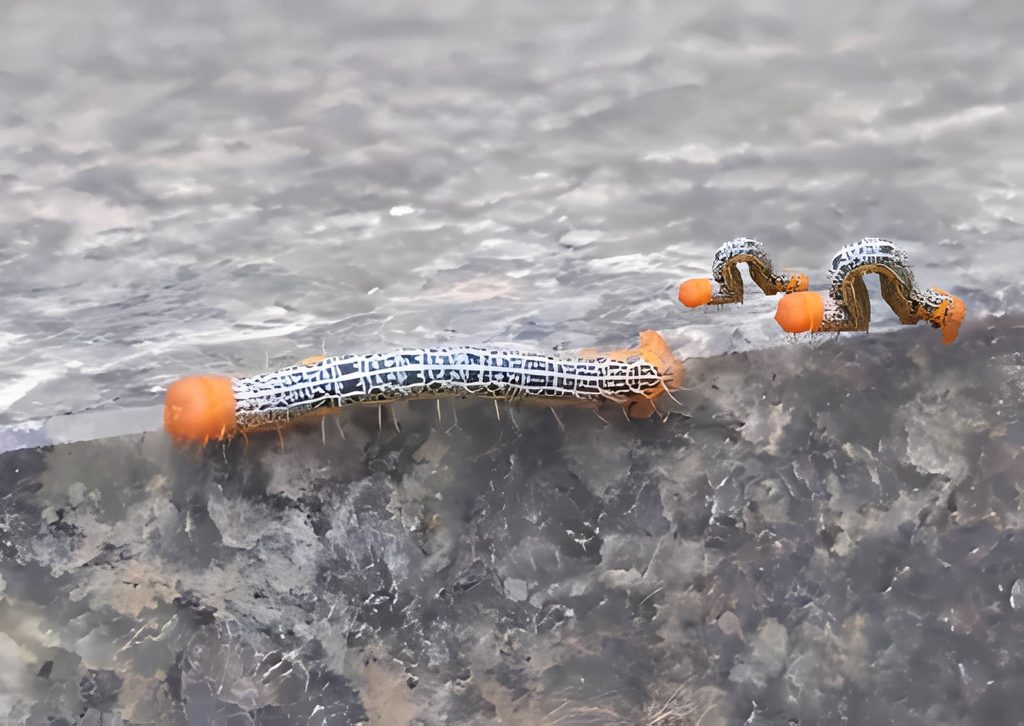
The closest image is “the inchworm’s bend,” from the “Appended Statements” of the Book of Changes. This caterpillar draws itself into a loop like the Greek letter omega (Ω), then stretches forward. The phrase describes lying low for a time, waiting for a chance to put one’s abilities to use.
The inchworm’s bend is about gathering strength for a later advance. The original idiom shares its pattern of bending before extending, but it also asks us to consider the terms of an exchange: whether that small concession has cost us our fundamental convictions.
Stepping back may be wise when all that changes is our method. Where integrity is the price, even a substantial gain may not be progress. A report’s figures can be massaged until they no longer tell the truth; a product’s defects can be quietly concealed. Either may spare us trouble for the moment while allowing our standards to slip.
Out of True
The bargain is a small loss for a larger gain. Mencius adds a question no unit of measure can answer: are we merely adjusting our posture—or losing our backbone?
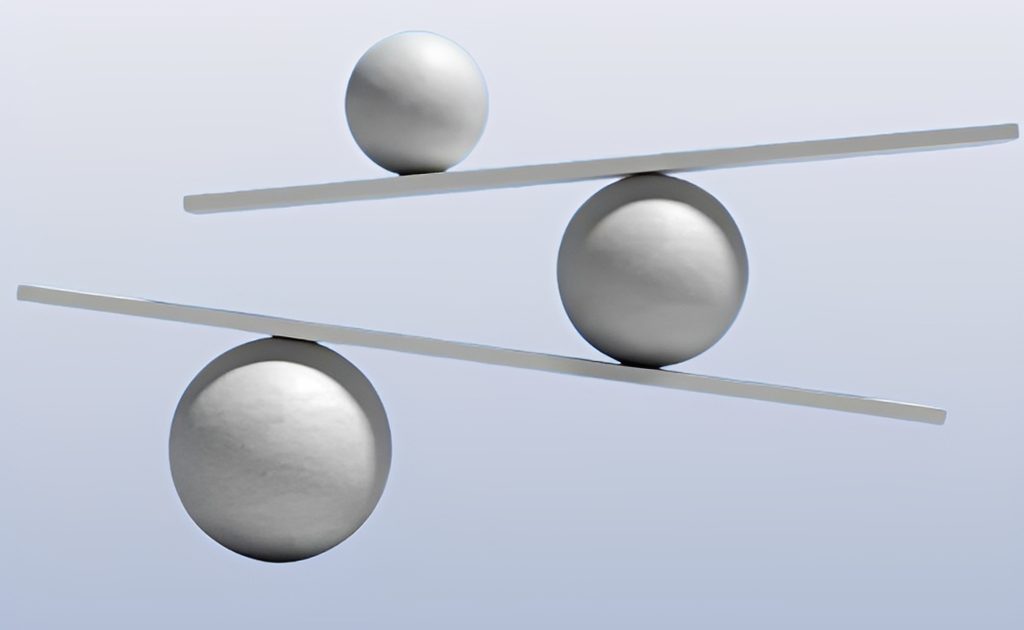
Questions of right and wrong often lie in acts small enough to escape notice: a number touched up, a promise left vague for convenience, an untruth no one wishes to acknowledge. Such departures are like a slight misalignment in a fan’s ribs. The fault may be invisible while the fan is folded. As it opens, the imbalance becomes clear.
Bamboo can be pared thin, and a fan folded into the hand. Its form has room to change, so long as the ribs that support it remain true. A ruler can mark off one measure or eight. It cannot tell us how far a small departure may eventually carry us from the road we meant to follow.
The idiom asks for the poise of a folding fan: room to draw in or reach out, with a sure sense of what must hold.
References
- Editorial Office of the Ministry of Education Mandarin Dictionary. “Bending a Little to Gain Much.” Dictionary of Chinese Idioms. National Academy for Educational Research. Accessed June 15, 2026.
https://dict.idioms.moe.edu.tw/idiomView.jsp?ID=9754&webMd=2&la=0 - Editorial Office of the Ministry of Education Mandarin Dictionary. Entries on “Temporary Expedient,” “Yielding to Preserve the Whole,” “Enduring Humiliation for the Sake of Duty,” “Retreating in Order to Advance,” and “The Inchworm’s Bend.” Dictionary of Chinese Idioms. National Academy for Educational Research. Accessed June 15 and July 13, 2026.
https://dict.idioms.moe.edu.tw/idiomView.jsp?ID=1105&q=1
https://dict.idioms.moe.edu.tw/idiomView.jsp?ID=1046&q=1
https://dict.idioms.moe.edu.tw/idiomView.jsp?ID=197&q=1
https://dict.idioms.moe.edu.tw/idiomView.jsp?ID=12791&q=1
https://dict.idioms.moe.edu.tw/idiomView.jsp?ID=18827&webMd=1&la=0 - Mencius, “Duke Wen of Teng, Part II,” section 6. Chinese Text Project. Accessed June 15, 2026.
https://ctext.org/mengzi/teng-wen-gong-ii/zh
Written by Dr. Yuman Shang
Sponsored by Prof. Mei-Hua Hall