
A-Meng of Wu
A Chinese Idiom, From an Unformed Beginning to a Life Recast
Beyond the Battlefield Lay Books
A life is rarely shaped by origin alone. A person may begin from a narrow place and still rise beyond it. More than a thousand years later, Lü Meng is still remembered not only for his military achievements, but for what his story reveals: through study, a person can change the terms by which others know him and reshape how his value is understood.

During the Three Kingdoms period, in Eastern Wu (or Dong Wu), there was a military commander named Lü Meng. He was brave and capable in battle, but books had never been his strength. Sun Quan, the ruler of Eastern Wu, saw more than Lü Meng’s proven courage. He saw a larger promise in him one that had not yet had the chance to unfold.
Sun Quan had inherited the foundation built by his father and elder brother at a young age. Caught between the rival powers of Cao Wei and Shu Han, he understood that a commander entrusted with great responsibility could not depend merely on bravery and martial skill. So he urged Lü Meng, “The responsibilities you now carry demand more than courage; they require the discipline of study.”
This was more than advice; it was a serious reminder, and also an expression of expectation. Sun Quan was not asking Lü Meng to become a scholar buried in the classics. He wanted him to read history, to better understand people, power, and the tides of history, so that his discernment could become sharper and more far-reaching.
What made Sun Quan remarkable was that he did not confine Lü Meng to the role of “a man who only knows how to fight.” As a ruler, he knew how to see what a person might become. With Lü Meng, he also showed the patience of a mentor. Before Lü Meng had grasped the promise within himself, Sun Quan pointed him toward change and set him one step further along the path. That small step may later have become the turning point of his life.
What was most admirable about Lü Meng was that he took those words to heart. He did not hide behind the demands of military life. He began to read, and slowly the books he opened did more than furnish him with knowledge. They sharpened his discernment, steadied his mind, and prepared him to carry the weight of larger decisions.
Courage may win a battle. But only insight can show a commander the shape of the war: when to press forward, when to draw back, and when a passing advantage should not be mistaken for a lasting victory.
Seen Anew, No Longer Defined by Yesterday

Later, Lu Su, an important minister of Eastern Wu, spoke with Lü Meng on matters of war and governance. He had assumed that Lü Meng was simply a brave warrior. But before long, he realized that Lü Meng’s knowledge and depth of mind had reached a level he had never expected.
Lu Su looked at him with sudden astonishment. “You are no longer the A-Meng of Wu you once were,” he admitted.
This was no casual praise. Lu Su had helped Sun Quan secure Jiangdong and was valued for his foresight and strategy. If even Lu Su was startled, then the old measure no longer fit the man before him.
Lü Meng replied, “A man given time may outgrow the name once placed upon him.”
Lü Meng’s reply was elegant because it rested on proof. It was not bravado, but the quiet assurance of a man who had done the work. Real growth often moves in silence. It gathers in the books one has read, the effort one has given, and the long nights one has endured, until one day a sentence, a conversation, or a decision makes the old image of him impossible to keep.
Before the Sword Gleams, Who Notices the Light?
“A-Meng of Wu” is often used for someone whose learning is still slight and whose vision remains narrow. But the story asks for more than a quick conclusion. It leaves room for what has not yet had time to take shape.
Sun Quan was the first to see that unwritten possibility in Lü Meng. Lü Meng was the one who answered that trust with effort. Lu Su was the one who finally saw that the old name no longer held him.
No one is remade entirely alone. Change begins when another person sees beyond what we are now; it deepens when we answer that faith with effort; and it becomes visible when others are willing to meet the person we have become, rather than the person they remember.
From Limitation to Transformation
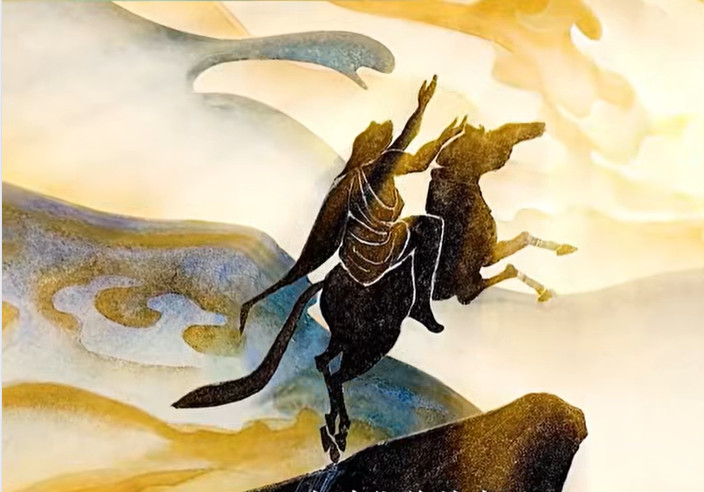
Although “A-Meng of Wu” invites us to think about study, transformation, and the ways we come to know other people, the idiom itself still points to a person with modest learning and fragile grounding. It is not a general label for someone who has simply changed a great deal.
For that reason, calling someone “A-Meng of Wu” directly can carry a note of condescension or mockery. To praise someone’s progress, the idiom needs to be framed differently: “no longer the A-Meng of Wu,” “no longer the A-Meng he once was,” or “a man given time may no longer be held by the name once attached to him.” Only then does the meaning become complete, and less likely to wound.
For example: When he first joined the company, he knew nothing about project management and was indeed like A-Meng in his early days. But after two years of steady study and hard work, he is now able to lead a project on his own.
Similarly, when this student first began to write, her work was hesitant and raw. Now her essays have structure, clarity, and force of argument. She is no longer the A-Meng she once was.
At its deepest, the idiom recognizes that people do not all begin from the same place. It reminds us not to confuse an earlier version of someone with the whole of who that person may become, and not to turn a temporary limitation into a lifelong boundary. Growth, when earned, deserves the chance to be met without the shadow of an old name.
A story is not settled by its first page. What matters is whether, even midway through, one is willing to write it another way. The name of the past records only where one came from; today’s effort is what allows the remaining chapters to unfold differently.
References
- Editorial Office of the Ministry of Education Mandarin Dictionary. “A-Meng of Wu,” Dictionary of Chinese Idioms, National Academy for Educational Research. Accessed May 15, 2026.
https://dict.idioms.moe.edu.tw/idiomView.jsp?ID=582&webMd=2&la=0 - Records of the Three Kingdoms, Book of Wu, Biography of Lü Meng, entry 6, Chinese Text Project. Accessed May 15, 2026.
https://ctext.org/text.pl?node=604220&if=gb#n604226
Written by Dr. Yuman Shang
Sponsored by Ms. Mei-Hua Hall